> ## Documentation Index
> Fetch the complete documentation index at: https://developer.box.com/llms.txt
> Use this file to discover all available pages before exploring further.
# Setup with Client Credentials Grant
export const MultiRelatedLinks = ({sections = []}) => {
if (!sections || sections.length === 0) {
return null;
}
return
;
};
export const Link = ({href, children, className, ...props}) => {
const localizedHref = localizeLink(href);
return
{children}
;
};
## Prerequisites
To set up a Platform App using server-side authentication, you need to ensure
you have access to the [Developer Console][devconsole] from your Box enterprise
account. Alternatively, you may sign up for a [developer account][devaccount].
## App creation steps
### Create a Server Authentication app
1. Log into Box and go to the [Developer Console][devconsole].
2. Click **New App**.
3. Select **Server** as the app type.
4. Click **Create**.
Client Credentials Grant (CCG) is the default authentication method for new
Server Authentication apps, so clicking **Create** produces a CCG app. Your
enterprise's **Switch server app auth type (CCG or JWT)** setting only affects
whether you can change the method later: when switching is disabled, the
**Create a New App** dialog shows a **Select Method** step with CCG preselected,
and the method is fixed once the app is created.
When switching is enabled, you can change to
JWT at any time from the
**Configuration** tab. See
Changing between Client Credentials and JWT
for details.
## App Authorization
Server authentication applications must be authorized before use. The authorization process depends on your account type.
**Free developer accounts**: Your app is automatically authorized when you create it. If authorization did not complete, the **Configuration** tab displays a prompt to authorize the app.
**Enterprise accounts**: After you create the app, the **Configuration** tab prompts you to submit the app for admin approval.
**Enterprise admins and co-admins**: The **Configuration** tab lets you authorize the app directly after creation.
## Basic configuration
### Application Access
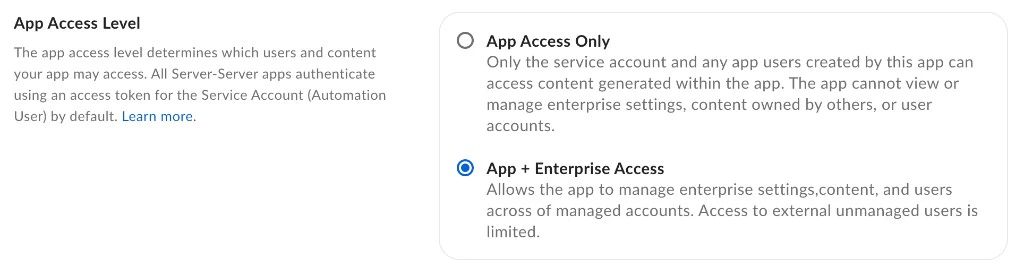
An application's access level determines which users and content your app may
access. By default, an application can only successfully interact with the
content of its Service Account and any App Users. To also
access existing Managed Users of an enterprise, navigate to the
**App Access Level** setting on the **Configuration** tab of the
[Developer console][devconsole] and set to **App + Enterprise Access**.
To authenticate as a Managed User or Admin, enable **Generate User Access Tokens** in the **Additional Configuration** section of the **Configuration** tab.
### Application Scopes
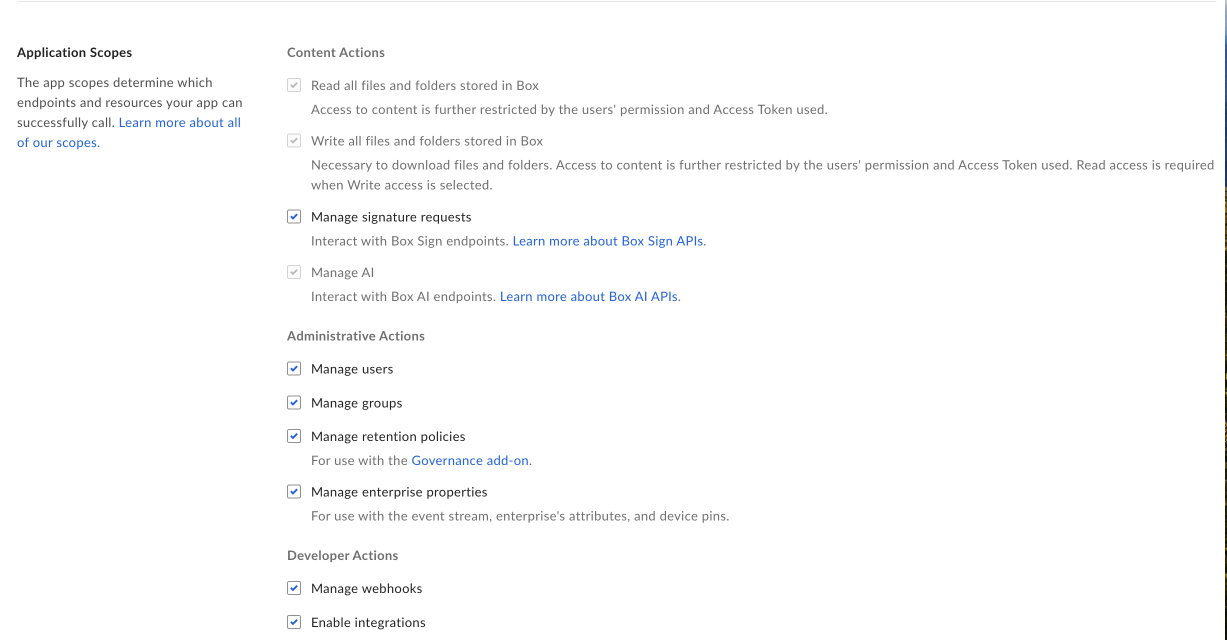
An application's scopes determine which endpoints and resources an application
can successfully call. See the scopes guide for detailed information
on each option.
### CORS Domains
If your application makes API calls from front-end browser code in
Javascript, the domain that these calls are made from needs to be
added to an allow-list due to [Cross Origin Resource Sharing][cors],
also known as CORS. If all requests are made from server-side code,
you may skip this section.
To add the full URI(s) to the allow-list, navigate to the **CORS Domain**
section at the bottom of the **Configuration** tab in the
[Developer console][devconsole].
## Using SDKs and Client Credentials Grant
To learn more about Client Credentials Grant for each SDK head over to:
* [.Net][.Net]
* [Java][Java]
* [Python][Python]
* [Node][Node]
* [IOS][IOS]
[.Net]: https://github.com/box/box-windows-sdk-v2/blob/legacy/docs/authentication.md#server-auth-with-ccg
[Java]: https://github.com/box/box-java-sdk/blob/legacy/doc/authentication.md#client-credentials-grant
[Python]: https://github.com/box/box-python-sdk/blob/legacy/docs/usage/authentication.md#client-credentials-grant
[Node]: https://github.com/box/box-node-sdk/blob/legacy/docs/authentication.md#client-credentials-grant-authentication
[IOS]: https://github.com/box/box-ios-sdk/blob/legacy/BoxSDK/docs/usage/authentication.md#client-credentials-grant
[devconsole]: https://app.box.com/developers/console
[devaccount]: https://account.box.com/signup/n/developer
[cors]: https://en.wikipedia.org/wiki/Cross-origin_resource_sharing
 ### CORS Domains
If your application makes API calls from front-end browser code in
Javascript, the domain that these calls are made from needs to be
added to an allow-list due to [Cross Origin Resource Sharing][cors],
also known as CORS. If all requests are made from server-side code,
you may skip this section.
To add the full URI(s) to the allow-list, navigate to the **CORS Domain**
section at the bottom of the **Configuration** tab in the
[Developer console][devconsole].
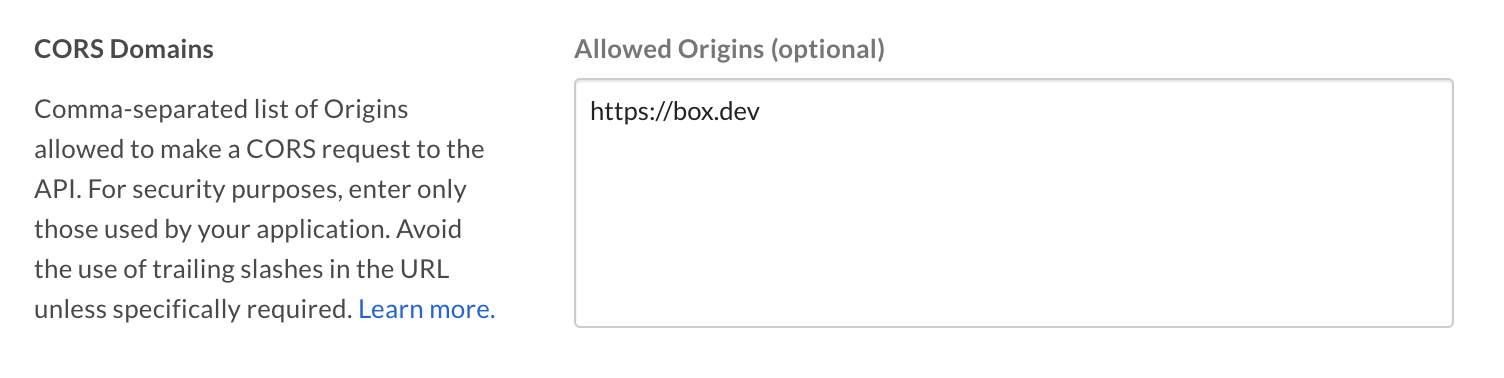
### CORS Domains
If your application makes API calls from front-end browser code in
Javascript, the domain that these calls are made from needs to be
added to an allow-list due to [Cross Origin Resource Sharing][cors],
also known as CORS. If all requests are made from server-side code,
you may skip this section.
To add the full URI(s) to the allow-list, navigate to the **CORS Domain**
section at the bottom of the **Configuration** tab in the
[Developer console][devconsole].
 ## Using SDKs and Client Credentials Grant
To learn more about Client Credentials Grant for each SDK head over to:
* [.Net][.Net]
* [Java][Java]
* [Python][Python]
* [Node][Node]
* [IOS][IOS]
[.Net]: https://github.com/box/box-windows-sdk-v2/blob/legacy/docs/authentication.md#server-auth-with-ccg
[Java]: https://github.com/box/box-java-sdk/blob/legacy/doc/authentication.md#client-credentials-grant
[Python]: https://github.com/box/box-python-sdk/blob/legacy/docs/usage/authentication.md#client-credentials-grant
[Node]: https://github.com/box/box-node-sdk/blob/legacy/docs/authentication.md#client-credentials-grant-authentication
[IOS]: https://github.com/box/box-ios-sdk/blob/legacy/BoxSDK/docs/usage/authentication.md#client-credentials-grant
[devconsole]: https://app.box.com/developers/console
[devaccount]: https://account.box.com/signup/n/developer
[cors]: https://en.wikipedia.org/wiki/Cross-origin_resource_sharing
## Using SDKs and Client Credentials Grant
To learn more about Client Credentials Grant for each SDK head over to:
* [.Net][.Net]
* [Java][Java]
* [Python][Python]
* [Node][Node]
* [IOS][IOS]
[.Net]: https://github.com/box/box-windows-sdk-v2/blob/legacy/docs/authentication.md#server-auth-with-ccg
[Java]: https://github.com/box/box-java-sdk/blob/legacy/doc/authentication.md#client-credentials-grant
[Python]: https://github.com/box/box-python-sdk/blob/legacy/docs/usage/authentication.md#client-credentials-grant
[Node]: https://github.com/box/box-node-sdk/blob/legacy/docs/authentication.md#client-credentials-grant-authentication
[IOS]: https://github.com/box/box-ios-sdk/blob/legacy/BoxSDK/docs/usage/authentication.md#client-credentials-grant
[devconsole]: https://app.box.com/developers/console
[devaccount]: https://account.box.com/signup/n/developer
[cors]: https://en.wikipedia.org/wiki/Cross-origin_resource_sharing